Agents, Skills etc.
Building an AI-enabled computing environment.
These are some of the skills and workflows that I am experimenting with.
Instruction: Model Selection
In my Claude account, I have added the following instruction: “At the beginning of every session, remind me to think about which model I should be using.”
This serves several purposes:
- Frugality as a habit: Use the least expensive resource you can for the work you need done. My default is set to the cheapest/quickest model. I select a more powerful model if I know I need it, or if Claude suggests it based on my prompt.
- Learning: The models do vary in quality and focus. Pausing to think about the task, and which model is best suited to execute it, is a good way to build up my understanding of the models’ capabilities.
Skill: Grill Me
When I started building tools and workflows in Claude, I soon realised that my prompts were not precise enough. Though I’m not obsessed with trying to “one shot” my way to success, I didn’t want to have to make huge course corrections with every iteration.
This skill is a structured way of surfacing second- and third-order design decisions up front, enriching the context for the model before it begins building.
This is the widely used version: mattpocock/skills on GitHub. But it is built for Claude Code. As I am currently on the claude.ai interface, I asked Claude to build a corresponding skill.
I add it at the end of every large “build” prompt, and it has helped me to design things more carefully. Some of the questions miss the mark, but overall it has been useful.
Skill: Test Me
I use Claude to learn new concepts, and sometimes I ask Claude to prepare a briefing note. I noticed that I was skimming these notes rather than reading them, so I implemented a good old “concept question” technique. Every briefing note is now followed by three concept questions about the content of the note, which I attempt to answer in my own words.
The “in my own words” part is important. Multiple choice questions are easier to administer and faster to complete, but they just don’t work as well as requiring a full sentence.
I built it within Claude with the following prompt: “I’d like to create a skill for claude called “test-me”. I intend to do a lot of learning of technical material with the help of AI, so I would like there to be a relatively quick, almost reflexive “concept check” step at the end of every primer. Can you create a skill like this, that can be invoked when new material is being presented to me?”
It is working as intended: When I am genuinely trying to absorb new concepts, rather than just “get things done”, this serves as a useful cognitive brake.
Skill: Map Transaction
I use Claude to understand complex financing transactions, especially in industries that are new to me. One of the most helpful exercises I would do, whether as a lawyer or finance director, was to map out a transaction. (Indeed this skill will probably become a post in my Business Skills for Lawyers resource!)
Claude did a good job when I asked it to map out the flow of assets, money and obligations between the parties. I felt that this was too good to just leave to chance, so I asked Claude to turn this into a skill that can be reused. The output is below:
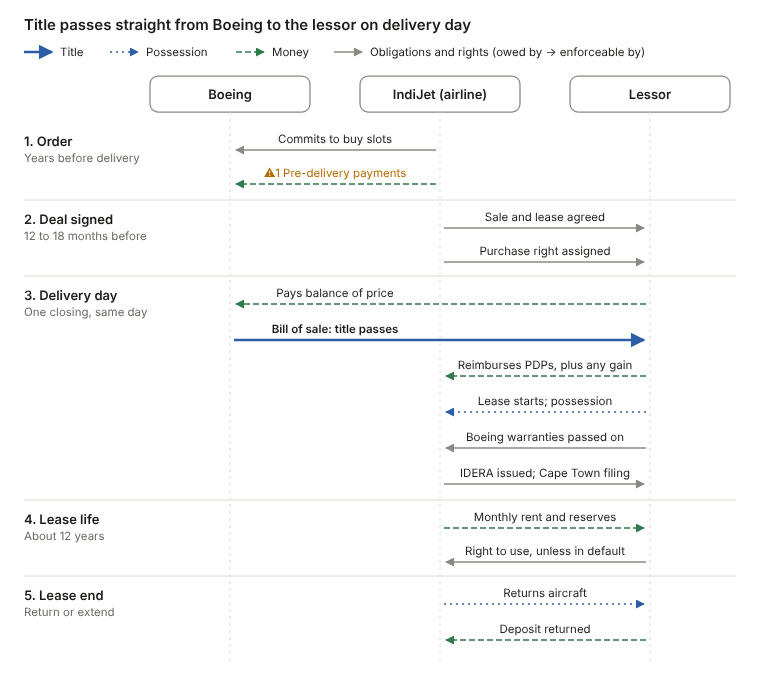
Figure 1: Example output: an aircraft sale-and-leaseback, mapped step by step.
I had built an alternative version to this skill, which uses swimlanes for the assets, money and obligations, and has more detail. I may build that out further - it’s more useful for tracking the deep mechanics of a deal. This first iteration of the skill is more appropriate for understanding the high-level flows and obligations of the parties.
Skill: Munger mode - Invert
One of the most useful techniques in evaluating a course of action, is to focus on what can go wrong. I came across Charlie Munger’s exhortation to “invert” recently, and found his explanation of the idea to be one of the most lucid. I have crystallised it in Claude with the instruction: “Ask the question: ‘What would be the most effective way to ensure the failure of this idea or project?’”.
Claude has come back with the following entry in my skills card: “Munger mode: invert an idea or project by asking how to guarantee its failure, then rank the failure routes and turn them into guardrails. Use to stress-test a plan, decision or project.”